Home / News / Industry News / Can Retractable Screens Make a Louvered Pergola More Practical for Modern Patios?
2026-09-25
Linhai Lezama Leisure Products Co., Ltd.
Outdoor patio design is moving toward more adaptable spaces where shade, privacy, ventilation, and insect control are considered together rather than as separate additions. In 2026, retractable screens are increasingly being discussed alongside motorized louvered roofs because they can help create a more enclosed outdoor environment while keeping the structure visually open when the screens are raised. For overseas buyers, this raises an important specification question: should screens be planned from the beginning when selecting a Louvered Pergola For Patio Use?
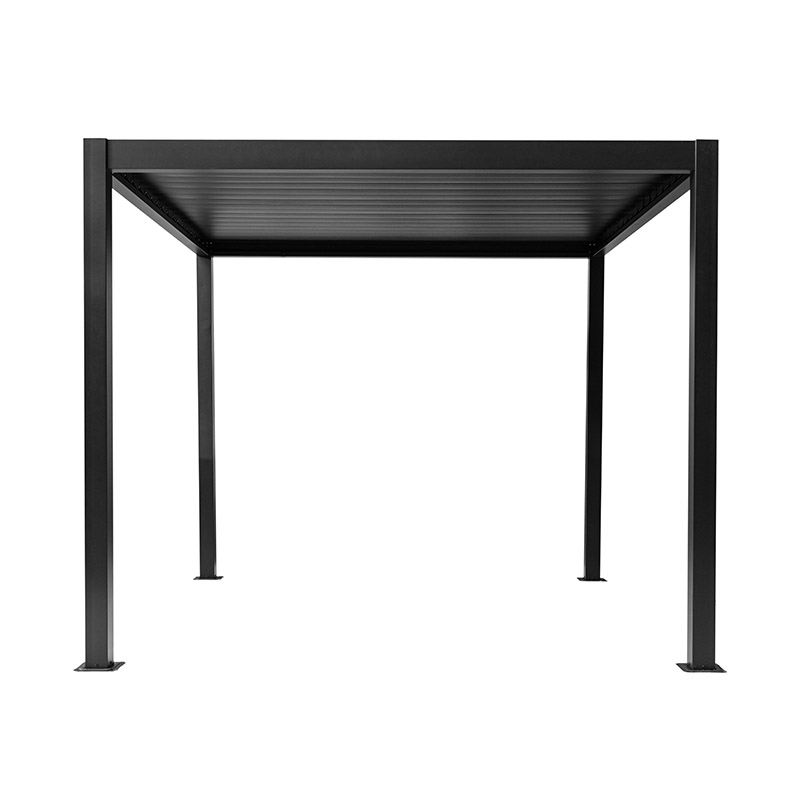
Adjustable louvers primarily manage conditions from above, but patios can still receive strong afternoon sunlight from the sides. Wind, insects, and limited privacy can also affect how comfortably the space is used.
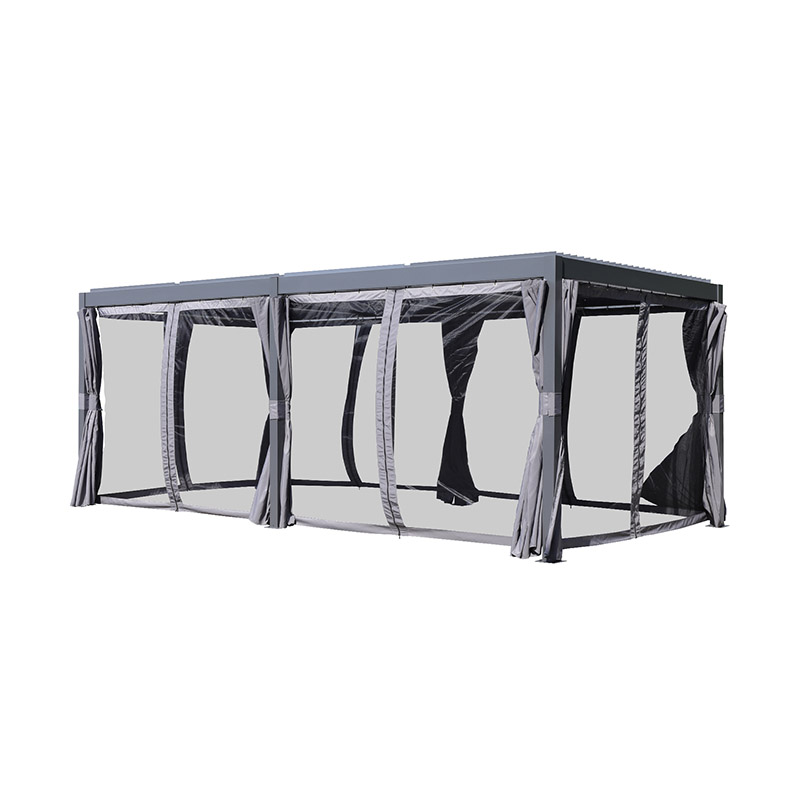
A retractable screen provides another layer of control without permanently closing the patio. When needed, it can reduce direct sunlight, create greater privacy, or help limit insects. When conditions are comfortable, the screen can be raised to maintain an open connection with the surrounding landscape.
One of the most common mistakes in custom outdoor projects is treating screens as an accessory that can simply be added later. Motorized screens require suitable mounting space, straight side tracks, protected wiring, and sufficient clearance for operation.
From a manufacturing perspective, we recommend coordinating the screen with the main structure during the design stage. This allows the frame dimensions, beam positions, control wiring, and accessory mounting points to be considered together rather than modified after production.
Not every patio requires the same screen material. A residential dining area may prioritize visibility and insect protection, while a commercial terrace may place greater emphasis on privacy or solar control.
Buyers should evaluate:
The right balance depends on how the space will actually be used rather than simply choosing the darkest or most enclosed screen.
A screen can improve comfort, but it also changes the way air moves through the patio. When fully lowered, it can create additional resistance to wind, making site conditions important to the overall design.
For exposed patios, rooftop terraces, coastal properties, and commercial installations, project teams should review the relationship between screen dimensions, mounting structure, guide tracks, and local wind conditions. A responsible manufacturer should discuss these factors before confirming the final configuration instead of treating the screen as a purely decorative option.
Motorized systems can make it easier to coordinate the roof and side screens according to changing conditions. Current outdoor-living trends also show growing interest in integrating lighting, heating, screens, and smart controls into a unified patio environment.
For procurement teams, however, convenience should not be the only consideration. Motor compatibility, control methods, power requirements, manual operation, and maintenance access should be confirmed before production.
Restaurants, hotels, resorts, and other hospitality spaces often have different requirements from private patios. One section may need privacy during dining hours, while another may remain open for better visibility or ventilation.
A modular approach can allow different screen positions, roof zones, and accessory combinations within the same overall project. This flexibility can be particularly useful when an outdoor area serves several functions throughout the day.
As a manufacturer, we recommend treating the pergola, louvers, screens, motors, lighting, and other accessories as one coordinated system during the engineering stage. This helps prevent conflicts between components and makes packaging, installation, and after-sales support easier to manage for overseas buyers.
For distributors and project contractors, the goal should not simply be to add more features. A well-planned Louvered Pergola For Patio Use should combine adjustable overhead coverage with carefully selected side protection, creating a patio environment that remains flexible without becoming unnecessarily complicated.
Recommended Products

For any inquiries, please contact us.
Tel: +86-0576-85118676 / 18905767077
No. 26, Changtangan, Lingjiang River, Linhai City, Taizhou City, Zhejiang, China


 English
 Deutsch
 Español